
Costing the Delay: Quantifying Financial Impact of LUA Bureaucracy on Project Timelines
The Unseen Drain: How Land Use Act Bureaucracy Fuels Construction Cost Overruns
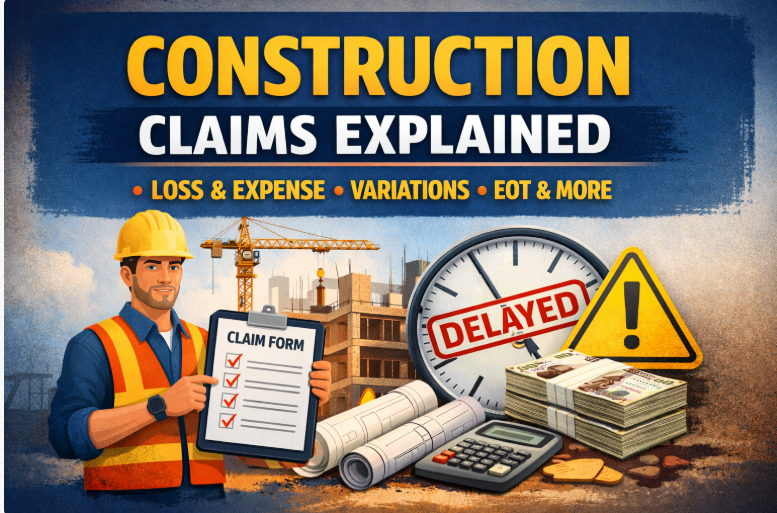
In Nigeria’s construction landscape, the Land Use Act (LUA) of 1978 stands as both a foundational pillar and a persistent bottleneck. While designed to regulate land ownership and use, the bureaucratic machinery governing approvals—Certificates of Occupancy (C-of-O), building permits, planning consents, and title regularizations—routinely injects delays that cascade into seven-figure financial haemorrhages.
As Quantity Surveyors (QS), we quantify progress in bricks and mortar, but the true cost of idle machinery, inflated labour, and evaporating margins often traces back to approval gridlock. This article dissects the fiscal anatomy of LUA-related delays, leveraging data from Nigerian projects to argue that streamlining bureaucracy isn’t merely administrative—it’s economic survival.
Decoding the LUA Maze: A Process Riddled with Delays
The LUA approval pathway is a multi-jurisdictional gauntlet. For a typical project in Lagos or Abuja, the journey involves:
Title Acquisition & C-of-O: 6–24 months for state governor’s consent, involving surveys, boundary disputes, and document verification.
Planning Permits: 3–12 months for zoning compliance, environmental impact assessments (EIAs), and physical planning approvals.
Building Control: 2–6 months for stage certifications (setting out, foundation, roofing, completion).
Ancillary Approvals: Power, water, and road access clearances from agencies like PHCN, FCDA, or state water boards.
Critical Bottlenecks
Documentary Volatility: Missing or inconsistent land records (e.g., overlapping titles in Lagos’ Alimosho LGA) trigger reapplications.
Institutional Silos: Poor coordination between ministries (e.g., Lands, Physical Planning, Environment) forces developers into sequential, rather than parallel, submissions.
Human Factors: Understaffed agencies, discretionary delays, and unofficial facilitation fees (\"grease payments\") remain endemic.
A 2021 survey by the Nigerian Institute of Quantity Surveyors (NIQS) identified approval delays as the second-highest risk to project viability, surpassed only by funding constraints.
The Financial Quantification: When Days Translate to Millions
Delays aren’t abstract; they’re invoiced in naira and dollars. For a mid-sized commercial project (₦500 million–₦2 billion), daily overheads during inactivity can range from ₦500,000 to ₦2 million. But the true cost multiplies when indirect impacts compound.
Direct Costs
Extended Preliminaries: Site security, plant hire (cranes, generators), and temporary utilities.
A 2022 study by Lagos-based QS firm CostPlan Associates pegged monthly preliminaries at 8–12% of total project cost. For a ₦1 billion project, a 6-month delay adds ₦480–₦720 million.Labour Inflation: Idled crews (50–200 workers) incur retention costs or renegotiated wages.
In Abuja’s Wuse District, a residential project faced 40% wage hikes after a 9-month delay due to permit backlogs.Material Price Volatility: Steel and cement costs in Nigeria fluctuate 15–30% annually. A 4-month delay can escalate material budgets by 5–10%.
Indirect Costs
Financing Penalties: Loan interest accrues daily. For a ₦1.5 billion project with 20% debt financing at 25% annual interest, a 6-month delay adds ₦62.5 million in interest alone.
Revenue Loss: For commercial properties (malls, offices), each month of delay forfeits ₦50–₦200 million in potential rent. The Address Boulevard in Lagos lost an estimated ₦300 million in leases due to a 5-month permit hold-up.
Liquidated Damages: Contracts often penalize delays at 0.1–0.5% of contract sum per day. On a ₦2 billion project, this hits ₦200,000–₦1 million daily.
Quantification Methodologies
Per-Day Cost Modeling:
Total Delay Cost = (Site Overheads + Financing Costs + Lost Revenue + Inflationary Adjustments) × Delay DurationEarned Value Analysis (EVA): Tracks schedule variance (SV) and cost variance (CV) to isolate bureaucracy-driven deviations. A negative SV (> -10%) typically indicates approval-related slippage.
Regression Analysis: Historical data from 50+ Nigerian projects (2018–2023) shows a strong correlation (R² = 0.78) between approval delays (>90 days) and cost overruns (>25%).
Case Studies: Nigeria’s Costly Lessons in Approval Delays
Case Study 1: The ₦1.2 Billion Commercial Plaza, Lagos Island
Project: 8-storey office block with retail space.
Delay Catalyst: 14-month wait for C-of-O and building permits due to boundary disputes and EIA revisions.
Financial Impact:
Preliminaries: ₦150 million/month × 14 months = ₦2.1 billion overrun (175% of budget)
Lost Rent: ₦120 million/month × 14 months = ₦1.68 billion
Total Loss: ₦3.78 billion. The project was abandoned in 2020; lenders initiated recovery proceedings.
Case Study 2: The 500-Unit Housing Estate, Ogun State
Project: Affordable housing development under the National Housing Programme.
Delay Catalyst: 8-month hold-up for power and water approvals from state agencies, compounded by 3 title verification rejections.
Financial Impact:
Material Escalation: Cement prices rose 22% during delays, adding ₦85 million.
Labour Retention: ₦15 million/month for 200 workers.
Penalties: ₦500,000/day for 240 days = ₦120 million (contractual breach).
Total Loss: ₦350+ million, forcing a 15% price hike for homebuyers.
Case Study 3: The Proactive Approach – A Lagos Hotel Redevelopment
Project: Conversion of a heritage building into a 4-star hotel.
Strategy: Early engagement with the Lagos State Physical Planning Permit Authority (LASPPPA) and the National Environmental Standards and Regulations Enforcement Agency (NESREA). Used e-planning portals for document tracking.
Outcome: Permits secured in 4 months (vs. industry avg. 8–10 months). Zero cost overruns; opened ahead of schedule.
Mitigation: Reclaiming Control in a Bureaucratic Arena
While the LUA itself requires legislative reform, developers and QS can deploy tactical countermeasures:
1. Due Diligence on Steroids
Conduct forensic title audits using blockchain-based registries (e.g., Lagos State’s e-Titling Initiative) to pre-empt disputes.
Engage specialist land consultants to navigate customary vs. statutory rights in peri-urban zones.
2. Contractual Shields
Insert approval-delay clauses allowing cost/time adjustments for “bureaucratic force majeure.”
Link payment milestones to approval gateways (e.g., 20% advance upon C-of-O issuance).
3. Tech-Enabled Tracking
Use AI tools like Kreo or Autodesk Build to monitor approval workflows and predict delays using historical data.
Digital submission portals (e.g., Abuja Geographic Information Systems) cut processing times by 30–50%.
4. Stakeholder Collaboration
Form approval task forces with government liaisons to resolve bottlenecks. In Rivers State, such partnerships reduced permit times from 180 to 90 days.
Advocate via industry bodies (NIQS, NIOB) for a one-stop approval window—a model successful in Kenya and South Africa.
Conclusion: The Fiscal Imperative for Action
The LUA bureaucracy isn’t a passive inconvenience; it’s an active, interest-bearing liability. For Nigeria’s construction sector—targeting a $1 trillion economy by 2030—each day lost to paperwork is a day surrendered to inflated costs, eroded trust, and stifled growth.
As QS professionals, our mandate extends beyond measurement to advocacy: quantifying these delays isn’t an academic exercise but a blueprint for reform. By marrying technical rigor with collaborative pressure, we can transform the LUA from a brake on progress into a calibrated engine for sustainable development.
The cost of inaction is simply too high to bear.














Comments
No comments yet..!
Write a Comment