
Understanding Concrete Mix Grades and Torsional Links: What Every Construction Professional Should Know
In the world of construction, clarity is key. Yet, many professionals—even experienced ones—often confuse two commonly referenced concrete mix grade designations: C-grade and M-grade concrete. This confusion can lead to costly errors on site. Additionally, another area that is often misunderstood is the role of torsional links in reinforced concrete design, especially in circular beams.
Let’s break both topics down and connect the dots.
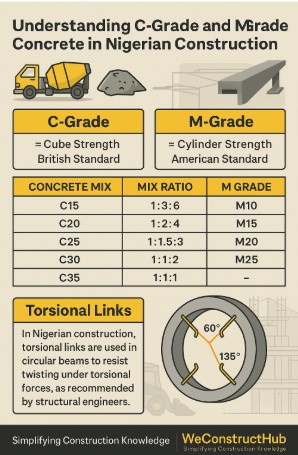
🔹 C-Grade vs. M-Grade Concrete: What’s the Difference?
One of the most common confusions in concrete specifications arises from the use of British Standard (BS) and American Standard (ASTM/ACI) mix grades.
📌 British Standard – C Grades (Cube Strength)
C15 = 1:3:6
C20 = 1:2:4
C25 = 1:1.5:3
C30 = 1:1:2
C35 = 1:1:1
These grades are defined by characteristic cube strength (MPa) at 28 days.
📌 American Standard – M Grades (Cylinder Strength)
M10 = 1:3:6
M15 = 1:2:4
M20 = 1:1.5:3
M25 = 1:1:2
M30 = 1:1.5:3 (Note: Often mixed up with M20 due to similar ratios)
The key difference lies in the specimen shape used for strength testing:
C-Grades are based on cube strength
M-Grades are based on cylinder strength
For example:
C20 concrete means 20 MPa cube strength
M15 concrete means 15 MPa cylinder strength
In Nigeria, the British Standard (C-Grades) is most commonly used in design and practice.
🔹 Let’s Talk About Torsional Links
Ever heard of torsional links?
They are specialized reinforcement links used in circular or curved beams, which are more prone to torsional (twisting) forces than standard rectangular beams.
📐 Key Features:
Torsional links are bent at 60° from the horizontal on both ends, unlike the regular single 135° bend.
Alternatively, they may be bent 135° from vertical on both legs, depending on design requirements.
Used particularly in circular beams, ring beams, or curved edge members.
Designed to resist torsion, a common issue in circle-like beam members.
🔧 Why They Matter:
Torsional reinforcement is not optional—it\'s a response to actual design forces and must be detailed when twisting or torque is expected. This is where competent structural engineering comes in.
🧠 Final Thoughts: Why You Should Care
Confusing concrete grades or overlooking torsional requirements can compromise structural performance and safety. As professionals in the construction industry, especially here in Nigeria, it\'s important to:
Know your standards: Stick to British Standards unless otherwise specified.
Read and interpret structural drawings properly: Torsional links aren’t decorative—they’re functional.
Consult structural engineers when in doubt. Design isn’t guesswork.
🔗 Stay tuned to WeConstructHub for more simplified, practical construction knowledge tailored to the Nigerian and African context.











Comments
Bldr Innocent . 21 Apr 2025 04-59:pm
This is indeed educative ✍️
Write a Comment