
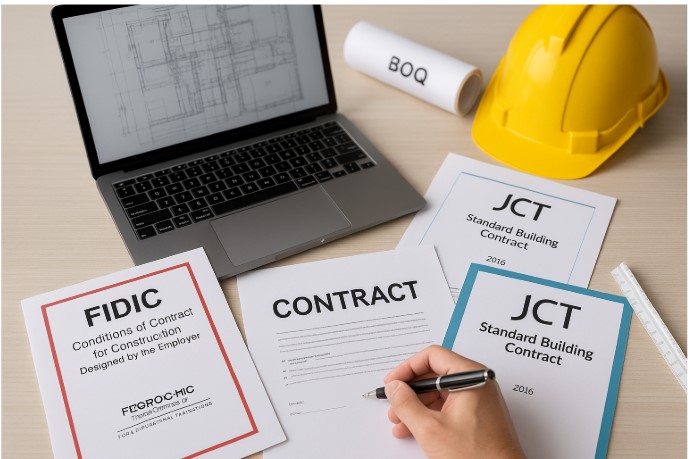
Understanding How to Use Common Construction Contract Documents: FIDIC, JCT, and More
Introduction
In construction, contracts are more than paperwork; they are the backbone of every successful project. But with several standard forms like FIDIC, JCT, and NEC, it can get confusing.
Which contract should you use?
How do they work?
What’s the difference?
In this article, WeConstructHub simplifies these contract documents and explains how to use them effectively, whether you\\\\\\\'re a student, contractor, consultant, or client.
📄 What Are Standard Form Contracts?
Standard form contracts are pre-prepared legal documents created by professional bodies to govern construction projects. They save time, reduce risks, and ensure fairness by clearly stating the duties, rights, and remedies of each party.
They are customizable and used worldwide.
🔍 Key Contract Types and How to Use Them
1. FIDIC (Fédération Internationale Des Ingénieurs-Conseils)
Popular Forms:
Red Book (Construction – Employer-designed)
Yellow Book (Design & Build – Contractor-designed)
Silver Book (EPC/Turnkey Projects)
Use Case:
Best for international projects, large infrastructure work, or projects funded by external organizations like the World Bank or AfDB.
How to Use:
Choose the right form (e.g., Red Book for traditional design-bid-build)
Customize the conditions (e.g., payment terms, dispute resolution)
Ensure all parties understand roles (e.g., employer, contractor, engineer)
Follow the procedures for variations, delays, claims, etc.
Strengths:
Widely accepted internationally
Strong dispute resolution process
Includes the engineer’s role as an impartial certifier
2. JCT (Joint Contracts Tribunal – UK)
Popular Forms:
JCT Standard Building Contract
JCT Design and Build
JCT Minor Works
Use Case:
Suitable for private or public building projects, especially in countries that follow British construction law.
How to Use:
Select based on procurement method (e.g., Design and Build vs Traditional)
Fill in the project particulars
Modify the optional clauses based on agreement
Administer through project manager/architect or contract administrator
Strengths:
Flexible and easy to use for buildings
Covers both design & build and traditional procurement
Well-understood in common law countries (like Nigeria)
3. NEC (New Engineering Contract – UK)
Popular Forms:
NEC4 ECC (Engineering and Construction Contract)
NEC4 TSC (Term Service Contract)
Use Case:
Favored in projects where collaboration and flexibility are key. Widely used in the UK public sector and gaining traction globally.
How to Use:
Select your main option (e.g., lump sum, target cost)
Use the early warning and risk register systems
Emphasize collaboration and quick issue resolution
Regular updates and communication are key
Strengths:
Promotes transparency and teamwork
Focused on timely issue resolution
Great for complex or long-term projects
4. Local Contracts (Nigeria-specific)
Government-issued contracts (e.g., Federal or State standard forms)
Custom contracts developed by consultants/clients
NIQS or NIA-recommended formats
Use Case:
Small to medium projects, government buildings, or contracts where all parties are locally based.
How to Use:
Read all clauses carefully
Ensure parties agree on payment, variation, and dispute terms
Add documents like BOQ, Drawings, Specifications
Tip: Always attach a program of work, schedule of payment, and contact details of supervising professionals.
⚠️ Things to Watch Out For
Don’t sign what you don’t understand – consult a construction lawyer if necessary
Tailor contracts – don’t just use default clauses
Clarify dispute mechanisms – is it arbitration, mediation, or court?
Attach necessary documents – drawings, BOQs, work schedules
✅ Summary Table
| Contract | Best For | Key Feature | Consider If |
|---|---|---|---|
| FIDIC | Infrastructure, Int’l Projects | Engineer role, risk allocation | You\\\\\\\'re working with foreign consultants or funding |
| JCT | Building projects | Simple, traditional format | You follow UK contract styles |
| NEC | Collaborative projects | Early warning, flexibility | You want a team-focused process |
| Local/Custom | Small/medium projects | Simpler language | You\\\\\\\'re working with only Nigerian parties |
📌 Final Thoughts
Contracts don’t have to be scary. They’re tools to help you build right and build confidently.
At WeConstructHub, we encourage every stakeholder, from students to project managers, to understand how these documents work. Choosing the right contract and knowing how to use it could save your project from delays, disputes, and disasters.
Want to learn more? Stay connected to WeConstructHub for more tutorials, templates, and guides on construction project success.











Comments
No comments yet..!
Write a Comment