
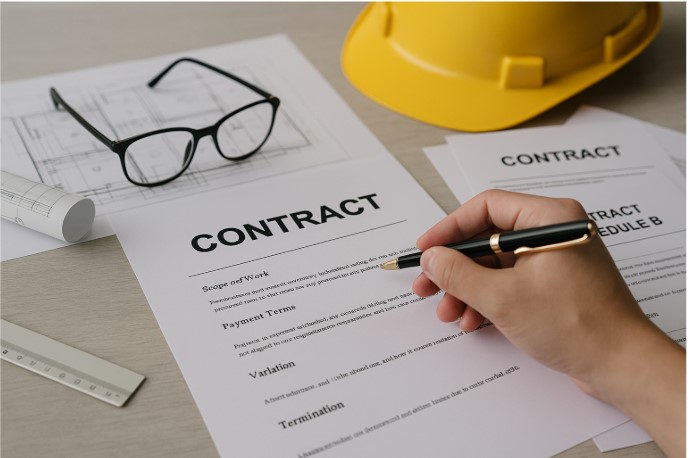
How to Easily Read Through a Construction Contract Document: Key Things to Watch Out For
Reading a construction contract can feel like navigating a maze, especially if you’re not a lawyer. But whether you\'re a contractor, QS, client, or student in the built environment, understanding your contract is essential to avoid costly mistakes.
In this post, WeConstructHub breaks down how to read and understand any construction contract with ease, and the key sections you should always pay attention to.
🔍 Why Reading the Contract Matters
Contracts are not just formalities, they define:
What you’re expected to deliver
What you’re expected to be paid
How long the project should take
What happens if things go wrong
Ignoring or misunderstanding a clause can lead to disputes, delays, or financial loss.
🧠 How to Read a Contract Without Stress
Follow these simple steps when reviewing a contract:
✅ 1. Start with the Scope of Work
This section explains what exactly needs to be done. Ask:
Is everything you discussed included?
Are there any unclear or missing parts?
Are responsibilities properly allocated?
Tip: Compare this with the BOQ, drawings, and specifications.
✅ 2. Check the Payment Terms
Look for:
Contract sum (total project value)
Payment method (milestones? stage-by-stage?)
Advance payment (if any)
Retention (how much will be held back?)
Final payment (when is it due?)
Tip: Be sure the payment terms match the project cash flow.
✅ 3. Understand the Timeline
When does the project officially start?
What\'s the project duration?
Are there penalties for delay (liquidated damages)?
Are extensions of time allowed, and how?
Tip: Make sure the timeline is realistic and clear.
✅ 4. Watch the Variation Clause
Construction projects often change. This section outlines:
How changes will be made
Who can issue variations (usually the client or consultant)
How variations are valued and approved
Tip: Don’t accept verbal instructions, always get variations in writing.
✅ 5. Look Out for the Dispute Resolution Clause
If a disagreement arises, how will it be settled?
Mediation?
Arbitration?
Litigation (going to court)?
Tip: Arbitration is often faster and cheaper than court cases.
✅ 6. Understand the Termination Clause
Can the contract be terminated early?
Under what conditions (non-performance, breach, etc.)?
What are the penalties or rights of each party?
Tip: Know your rights in case the client or contractor wants to pull out.
✅ 7. Review Insurance and Liability
Check who is responsible for:
Site insurance
Third-party liability
Workers’ injuries
Material losses (theft, fire, etc.)
Tip: This protects you from unexpected expenses.
✅ 8. Confirm Key Attachments
A contract is incomplete without these documents:
Drawings
BOQ
Work schedule/program
Specifications
Site layout plan
Make sure these are referenced and attached.
👀 Red Flags to Watch Out For
Vague wording like “as agreed later”
Missing or blank sections
Unfair penalties or one-sided clauses
No mention of dispute resolution
Verbal agreements not written in
📌 Final Tips
Read it slowly—take your time
Ask questions—if anything is unclear, seek clarity
Consult a professional—QS, architect, or lawyer
Always get a copy—don’t sign what you don’t have access to
✅ Conclusion
Understanding a construction contract isn’t just for lawyers; it’s for everyone involved. Reading carefully helps you avoid surprises, protect your interests, and deliver successful projects.
At WeConstructHub, we believe in empowering construction professionals with practical knowledge. Stay with us for more real-world insights, tutorials, and tools to make construction easier and smarter.







Comments
No comments yet..!
Write a Comment